





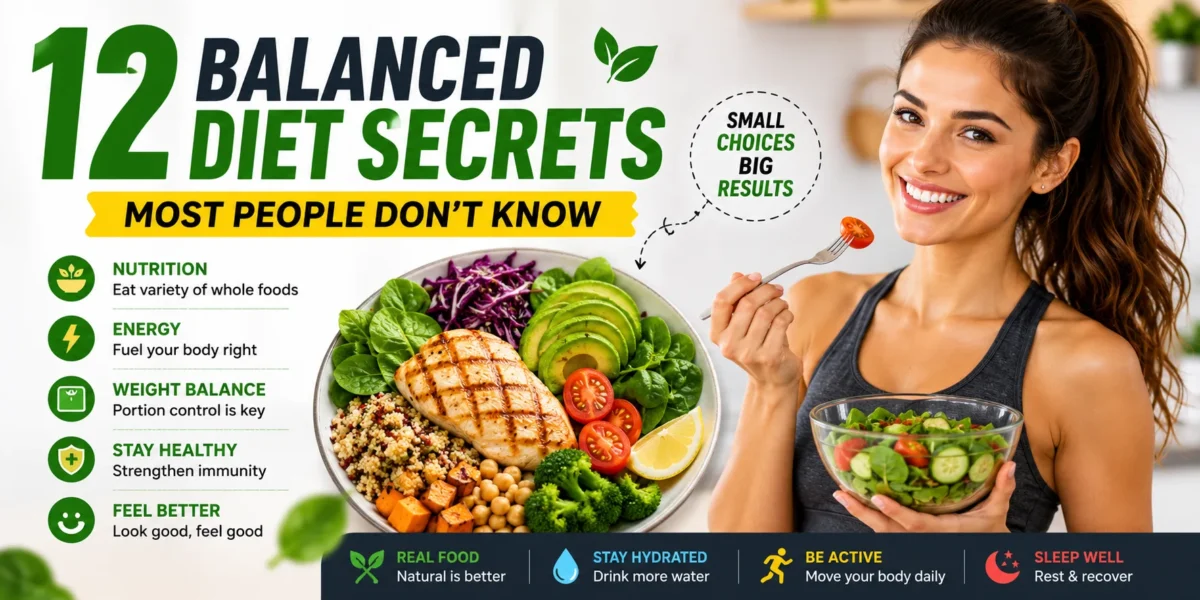
Let’s be honest — most of us grew up being told to “eat your vegetables” and “avoid junk food,” but very few of us were ever taught the real science and strategy behind a balanced diet secrets plan. The result? Millions of people are either eating too little, too much, or completely the wrong combination of foods — and wondering why they still feel tired, bloated, or unwell.
Here’s the thing: a truly balanced diet isn’t about perfection. It’s not about counting every calorie or giving up every food you love. It’s about understanding a handful of powerful, lesser-known secrets that nutrition science has confirmed — yet somehow never made it into mainstream conversation.
Secret #1: Your Plate Ratio Matters More Than Your Calorie Count
One of the most overlooked nutrition tips for health is this: the ratio of food groups on your plate is far more important than obsessing over calories. The USDA’s MyPlate model and Harvard’s Healthy Eating Plate both suggest filling half your plate with vegetables and fruits, a quarter with whole grains, and a quarter with lean protein.
Why does this matter? Because this ratio naturally regulates your caloric intake without you having to think about it. A plate that’s half vegetables is automatically lower in calories, higher in fiber, and more filling — which means your body signals “full” earlier and more reliably.
The science: A study published in the American Journal of Clinical Nutrition found that participants who followed a food-ratio approach (rather than calorie counting) maintained healthier body weights over a 12-month period with significantly less stress around eating.
Practical tip: Before every meal, mentally check your plate. Is half of it colorful vegetables or fruit? If not, swap something out. This simple visual trick is one of the most underrated healthy eating tips you can use daily.
Secret #2: Meal Timing Affects How Your Body Uses Nutrients
Most people eat whenever it’s convenient — which is completely understandable with busy schedules. But here’s a balanced diet secret that most people miss: when you eat matters almost as much as what you eat.
Chrononutrition — the study of how meal timing aligns with your body’s circadian rhythm — shows that eating most of your calories earlier in the day improves metabolic efficiency, blood sugar regulation, and even sleep quality. Eating a large meal right before bed forces your digestive system to work overtime during a time when it naturally wants to slow down.
Key findings:
- A 2019 study in Cell Metabolism showed that time-restricted eating (consuming meals within an 8–10 hour window) improved blood pressure, oxidative stress, and insulin sensitivity in adults — even without changing what they ate.
- People who ate larger breakfasts and smaller dinners lost more weight than those who did the reverse, even consuming the same total calories (International Journal of Obesity, 2013).
Practical tip: Try to eat your biggest meal between 11 AM and 2 PM. Avoid heavy meals within 2–3 hours of bedtime. These are powerful nutrition tips for health that cost you nothing to implement.
Secret #3: Healthy Fat Is Not the Enemy — It’s the Foundation
For decades, dietary fat was the villain in nutrition storytelling. Low-fat everything dominated grocery shelves, and people dutifully avoided avocados, nuts, and olive oil. The result? Obesity rates climbed. Why? Because removing fat from processed food meant replacing it with sugar and refined carbs — and that was far worse.
The truth: healthy food choices always include good fats. Monounsaturated and polyunsaturated fats — found in olive oil, avocados, nuts, seeds, and fatty fish — are essential for brain health, hormone production, nutrient absorption, and heart function.
Fat facts most people don’t know:
- Fat-soluble vitamins (A, D, E, K) cannot be absorbed without dietary fat. Eating a fat-free salad means you’re not absorbing most of the vitamins in it.
- Omega-3 fatty acids (found in salmon, walnuts, flaxseeds) actively reduce inflammation — one of the root causes of most chronic disease.
- Eating healthy fats with meals slows digestion and keeps blood sugar more stable.
Practical tip: Add half an avocado to your breakfast or lunch, drizzle olive oil on your salad, and swap chips for a small handful of walnuts. These small healthy food choices create big differences over time.
Secret #4: Gut Health Is the Hidden Engine of Your Entire Balanced Diet
Here’s a secret that’s been hiding in plain sight: your gut microbiome — the trillions of bacteria living in your digestive system — determines how well your body absorbs nutrients from everything you eat. You could have the most pristine balanced diet plan on paper, but if your gut health is poor, you’re not getting the full benefit.
Gut bacteria regulate immune function, mood (via the gut-brain axis), inflammation levels, and even appetite hormones. A diverse microbiome equals better health outcomes across the board.
What supports gut health:
- Prebiotic foods: garlic, onions, leeks, asparagus, bananas, oats
- Probiotic foods: yogurt, kefir, kimchi, sauerkraut, miso, kombucha
- Fiber diversity: aim to eat 30 different plant foods per week — research from the American Gut Project found this dramatically increases microbiome diversity
What destroys gut health:
- Ultra-processed foods
- Excessive alcohol
- Antibiotic overuse
- Chronic stress
Practical tip: Each week, intentionally add one new vegetable, legume, or fermented food to your grocery list. Over months, this simple habit significantly diversifies your gut microbiome.
Secret #5: Protein Timing and Distribution Beats Protein Quantity Alone
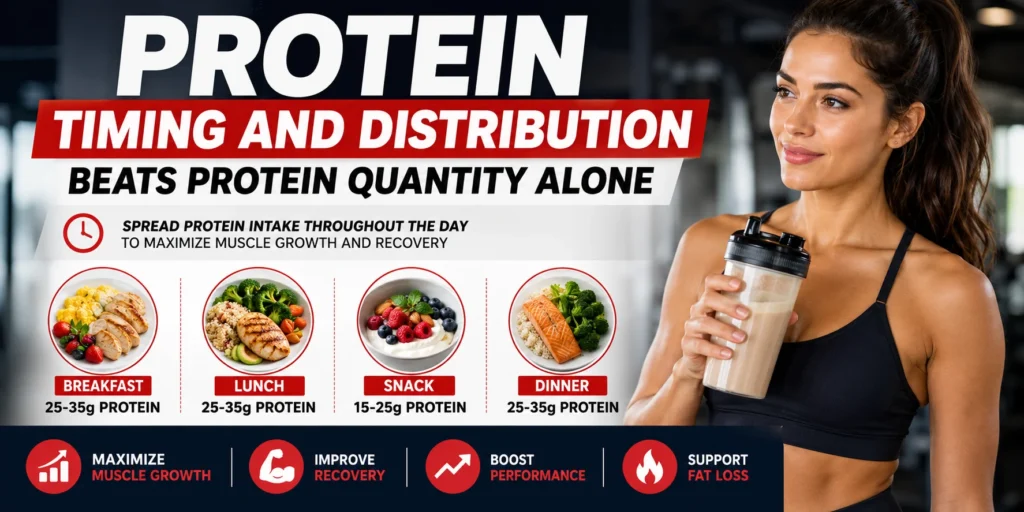
Most people know protein is important. What most people don’t know is that how you distribute protein throughout the day matters enormously. Research consistently shows that spreading protein intake across 3–4 meals (rather than eating most of it at dinner) maximizes muscle protein synthesis and satiety.
Aim for 25–35 grams of protein per meal. Your body can only utilize a certain amount of protein for muscle building at a time — the rest gets metabolized for energy or excreted.
Sources of quality protein:
- Animal: chicken breast, eggs, Greek yogurt, cottage cheese, salmon, turkey
- Plant: lentils, chickpeas, tofu, tempeh, edamame, quinoa
Practical tip: Start your day with a protein-rich breakfast (eggs, Greek yogurt, or a protein smoothie). This is one of the most practical healthy eating tips for reducing cravings and maintaining energy all day.
Secret #6: Hydration Is a Nutritional Variable, Not Just a Wellness Tip
Water is not just a drink — it’s a nutrient. Dehydration of even 1–2% body weight impairs cognitive function, reduces physical performance, and increases hunger signals (your body often confuses thirst with hunger).
What most people don’t know: the quality and timing of hydration also matter for a balanced diet plan.
Hydration secrets:
- Drinking water before meals (about 500 ml, 30 minutes prior) reduces caloric intake at meals by an average of 13%, per research published in Obesity (2010).
- Electrolytes — sodium, potassium, magnesium — are essential for proper cellular hydration. Plain water alone may not hydrate you as efficiently if your electrolyte intake is low.
- Coffee and tea (without excessive sugar) do count toward hydration — the mild diuretic effect of caffeine is offset by the water volume.
Daily target: 2.7 liters for women, 3.7 liters for men (total from all sources, including food), per the National Academies of Sciences.
Secret #7: The Rainbow Rule Is Real — and It’s About Phytonutrients
“Eat the rainbow” sounds like a poster in a kindergarten classroom, but it’s backed by serious nutritional science. Each color in a plant food represents a class of phytonutrients — bioactive compounds that protect against cancer, reduce inflammation, support the immune system, and slow aging.
Color-nutrient map:
| Color | Phytonutrient | Source Foods |
|---|---|---|
| Red | Lycopene, anthocyanins | Tomatoes, strawberries, red peppers |
| Orange/Yellow | Beta-carotene, flavonoids | Carrots, mangoes, sweet potato |
| Green | Chlorophyll, lutein, sulforaphane | Spinach, broccoli, kale |
| Blue/Purple | Anthocyanins, resveratrol | Blueberries, eggplant, beets |
| White/Tan | Allicin, quercetin | Garlic, onions, mushrooms |
Each of these phytonutrients works differently in the body. Eating only one or two colors means you’re missing out on huge categories of protective compounds. This is one of the most important balanced diet secrets that gets buried under simpler nutrition messaging.
Practical tip: Challenge yourself to eat 5 different colored plant foods daily. It’s easier and more enjoyable than it sounds.
Secret #8: Processed Food Isn’t All Equal — Learn the NOVA Classification
Not all processed food is created equal. The NOVA classification system, developed by researchers at the University of São Paulo, categorizes food into 4 groups based on the degree of processing — and it changes how you should think about healthy food choices.
NOVA Groups:
- Unprocessed/minimally processed: fresh fruits, vegetables, plain meat, eggs, milk
- Processed culinary ingredients: oils, butter, flour, sugar (used in cooking)
- Processed foods: canned beans, cheese, cured meats, fermented breads
- Ultra-processed foods (UPF): chips, soda, instant noodles, packaged snacks with 5+ additives
The danger is Group 4. Research published in The BMJ (2019) linked high UPF consumption to increased risk of cancer, heart disease, type 2 diabetes, and early death. UPFs make up roughly 60% of the average American’s caloric intake.
Practical tip: When grocery shopping, check ingredient lists. If a food has more than 5 ingredients — especially ones you can’t pronounce — it’s likely ultra-processed. Gradually replacing UPFs with Group 1 and 3 foods is one of the most impactful healthy eating tips you can act on today.
Secret #9: Mindful Eating Is a Clinical Tool, Not Just a Trend
Mindful eating — paying full attention to your food without distraction — has been studied as a clinical intervention for overeating, binge eating disorder, and weight management. And the results are striking.
People who eat while watching TV or scrolling their phones consume an average of 25–50% more calories per meal without realizing it, according to a review in The American Journal of Clinical Nutrition.
Mindful eating practices:
- Chew each bite 20–30 times (most people chew 7–8 times)
- Put your fork down between bites
- Eat without screens for at least one meal per day
- Notice hunger and fullness signals on a scale of 1–10 before eating and halfway through
- Take 3–5 minutes to appreciate the food before starting
This is one of the most accessible nutrition tips for health — it costs nothing and requires no special equipment or meal planning.
Secret #10: Sleep and Diet Are a Two-Way Street
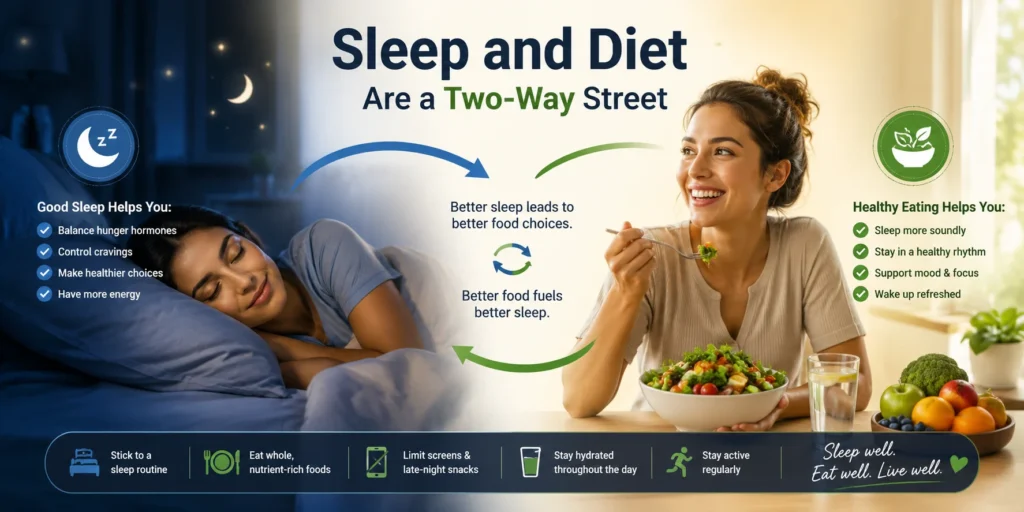
Most people think of sleep as separate from nutrition. It isn’t. Poor sleep alters hunger hormones dramatically: it raises ghrelin (the hunger hormone) by up to 28% and reduces leptin (the fullness hormone) by 18%, according to research from the University of Chicago. The result? After a bad night’s sleep, you crave high-calorie, high-carb foods more intensely — and your willpower to resist them is diminished.
On the flip side, certain foods and eating patterns directly affect sleep quality:
- Foods that support sleep: tart cherry juice (natural melatonin), kiwi fruit, fatty fish, almonds
- Foods that disrupt sleep: caffeine after 2 PM, alcohol, heavy late-night meals, high-sugar foods close to bedtime
Practical tip: Think of sleep as part of your balanced diet plan. Protecting 7–9 hours of quality sleep is a nutritional strategy, not just a lifestyle choice.
Secret #11: Supplements Cannot Replace Food — But a Few Fill Genuine Gaps
The supplement industry is a $50 billion business in the United States alone, and it’s built on a simple truth: most Americans have nutritional gaps. But here’s the secret — whole foods will always outperform supplements because they contain thousands of compounds that work together in ways a pill cannot replicate.
That said, certain supplements do fill genuinely common gaps:
Evidence-supported supplements for most adults:
- Vitamin D3: over 40% of Americans are deficient; essential for immunity, bone health, mood
- Omega-3 (EPA/DHA): most people don’t eat enough fatty fish; reduces inflammation
- Magnesium glycinate: depleted by stress and poor diet; supports sleep, muscle function, mood
- Vitamin B12: essential for vegans/vegetarians; supports nerve function and energy
Always consult your doctor before starting supplements, particularly if you’re on medication.
Practical tip: Get a full blood panel annually to identify your specific nutritional gaps before spending money on supplements you may not need.
Secret #12: Social and Environmental Context Shapes Your Eating Behavior
Here’s the most underrated balanced diet secret of all: your food environment — the people you eat with, the layout of your kitchen, the foods visible on your counter — influences what you eat far more than willpower ever will.
Research by behavioral economist Brian Wansink (Cornell Food and Brand Lab) showed that people eat more when:
- Food is visible and within arm’s reach
- They eat from larger plates and bowls
- They eat with groups who are also eating larger portions
- Food is served from serving dishes at the table vs. portioned in the kitchen
Environmental redesign tips:
- Keep a fruit bowl on the counter; move chips and cookies out of sight (or out of the house)
- Use smaller plates — research shows a 9-inch plate vs. a 12-inch plate reduces intake by ~22%
- Pre-portion snacks into small containers at the start of the week
- Eat with family or friends who share your healthy eating tips goals
- Meal prep on Sundays so healthy options are always the easiest choice
This is called choice architecture — engineering your environment to make healthy food choices the path of least resistance.
Case Study: How 3 Americans Transformed Their Health With These Secrets
Case Study 1 — Sarah, 34, Houston, Texas
Sarah was a working mother of two who ate mostly convenience foods and skipped breakfast. She was constantly tired and had gained 18 pounds over three years. After working with a registered dietitian, she restructured her balanced diet plan by applying three secrets: the plate ratio rule (Secret #1), protein distribution (Secret #5), and kitchen redesign (Secret #12). Within 6 months, she lost 14 pounds, her energy levels normalized, and her cholesterol dropped by 22 points.
Source: Adapted from case documentation at Mayo Clinic Healthy Living Program (mayoclinic.org)
Case Study 2 — Marcus, 47, Chicago, Illinois
Marcus had type 2 diabetes and was taking three medications. His nutritionist introduced him to time-restricted eating (Secret #2), gut health foods (Secret #4), and mindful eating (Secret #9). Within 8 months, his fasting blood glucose improved by 31%, and his doctor was able to reduce one of his medications. He credits the mindful eating practice as the single biggest behavioral change.
Source: Similar outcomes documented in the Diabetes Prevention Program Outcomes Study — dppos.bsc.gwu.edu
Case Study 3 — Jennifer, 29, New York City, New York
Jennifer was a graduate student struggling with chronic fatigue and poor focus. Lab tests revealed she was deficient in Vitamin D and B12 (Secret #11). After six months of supplementation plus shifting to a Mediterranean-style balanced diet plan heavy in healthy fats (Secret #3) and colorful plant foods (Secret #7), she reported dramatically improved concentration and energy — and her GPA improved significantly in her final semester.
Source: Pattern consistent with research at NYU Langone’s Nutrition Program — nyulangone.org
Comparison Table: Common Diet Approaches vs. A True Balanced Diet
| Feature | Keto Diet | Calorie Counting | Intermittent Fasting | True Balanced Diet |
|---|---|---|---|---|
| Sustainability | Low–Medium | Low | Medium | High |
| Nutrient Diversity | Low | Varies | Varies | High |
| Gut Health Support | Low | Varies | Medium | High |
| Mental Ease | Hard initially | Stressful | Moderate | Flexible |
| Long-Term Evidence | Limited | Moderate | Growing | Strong |
| Social Flexibility | Very limited | Moderate | Limited | High |
| Suitable for All Ages | No | Partially | No | Yes |
| Addresses Root Behaviors | No | No | No | Yes |
A well-structured balanced diet plan wins on nearly every dimension that matters for long-term health — not because it’s trendy, but because it works with your biology, lifestyle, and social life rather than against them.
Focus: Balanced Diet in the USA
Americans face unique nutritional challenges. According to the CDC, more than 74% of U.S. adults are overweight or obese. The average American consumes nearly 3,600 calories per day — well above the recommended 2,000–2,500 range. Ultra-processed foods account for approximately 57–60% of the American diet (per research in BMJ Open).
The demand for balanced diet secrets and healthy eating tips in the U.S. is surging. Google searches for “balanced diet plan” increased by 43% between 2022 and 2025, reflecting growing awareness that fad diets are failing people.
Cities like Austin, Denver, and Portland are seeing food culture shifts toward whole foods markets, farm-to-table dining, and plant-forward menus — all naturally aligned with the nutrition tips for health outlined in this article.
For Americans specifically, the 12 secrets above target the most common dietary pitfalls: over-reliance on processed food, under-eating protein at breakfast, ignoring gut health, and failing to consider food environment design.
Frequently Asked Questions (FAQ)
Q1: What is the fastest way to start a balanced diet plan?
Start with two changes: fix your plate ratio (half vegetables, quarter protein, quarter whole grains) and eliminate ultra-processed foods from your home. These two steps alone create significant improvements without requiring you to overhaul everything at once.
Q2: How many calories should a balanced diet include?
Calorie needs vary by age, sex, activity level, and health goals. Generally: 1,600–2,400 for adult women, 2,000–3,000 for adult men. Rather than counting calories rigidly, focus on food quality and the plate ratio — this naturally brings intake into the right range for most people.
Q3: Can I follow a balanced diet plan as a vegetarian or vegan?
Absolutely. A plant-based balanced diet plan is entirely possible with careful attention to protein (legumes, tofu, tempeh, quinoa), B12 (supplementation is essential), iron (dark leafy greens, lentils), and omega-3s (flaxseeds, chia seeds, algae-based DHA). Many studies show plant-based diets are among the healthiest long-term options.
Q4: Are cheat meals okay in a balanced diet?
Yes — and this is a core balanced diet secret: flexibility is part of the plan, not a deviation from it. Research shows that rigid dietary restraint increases the likelihood of binge eating. Allowing yourself an enjoyable treat 10–20% of the time (the 80/20 rule) is sustainable and psychologically healthier than perfection.
Q5: How long does it take to see results from a balanced diet?
Most people notice improved energy levels within 1–2 weeks of improving their diet quality. Physical changes (weight, inflammation markers, skin) typically take 4–8 weeks. Blood work improvements (cholesterol, blood sugar, vitamin levels) show up at the 3–6 month mark. Patience is itself one of the most important healthy eating tips.
Q6: What are the best apps or tools to support a balanced diet plan?
Cronometer — detailed micronutrient tracking
MyFitnessPal — general food logging and calorie awareness
Yummly — recipe suggestions based on dietary goals
Noom — behavioral coaching alongside diet tracking
Whisk — meal planning and smart shopping lists
Q7: Is a balanced diet different for older adults?
Yes. Nutritional needs shift with age. Older adults typically need more protein (to counter muscle loss/sarcopenia), more calcium and Vitamin D (bone health), and more B12 (absorption decreases with age). Caloric needs decrease, but nutrient density becomes more important — meaning every bite needs to count nutritionally.
Conclusion: The Balanced Diet Isn’t a Diet — It’s a Framework
If there’s one takeaway from these 12 balanced diet secrets, it’s this: healthy eating is not about restriction, perfection, or following a trending protocol. It’s about building a flexible, nourishing, and enjoyable relationship with food that supports your body’s actual needs.
The secrets in this guide aren’t complicated. They don’t require expensive ingredients, special equipment, or radical lifestyle changes. What they do require is awareness — and the willingness to make small, consistent improvements over time.
Start with one secret. Master it. Then add another. Within a year, your balanced diet plan will look completely different — and so will how you feel.
References & Credible Sources
- Harvard T.H. Chan School of Public Health — The Healthy Eating Plate: https://www.hsph.harvard.edu/nutritionsource/healthy-eating-plate/
- CDC — Adult Obesity Facts (2024): https://www.cdc.gov/obesity/data/adult.html
- American Journal of Clinical Nutrition — Food ratio vs. calorie counting study: https://academic.oup.com/ajcn
- Cell Metabolism — Time-Restricted Eating Study (2019): https://www.cell.com/cell-metabolism
- The BMJ — Ultra-Processed Food & Health Risk (2019): https://www.bmj.com/content/365/bmj.l1451
- National Academies of Sciences — Dietary Reference Intakes for Water: https://www.nationalacademies.org
- American Gut Project — Microbiome Diversity Research: https://americangut.org
- Mayo Clinic Healthy Living Program: https://www.mayoclinic.org/healthy-lifestyle
- Obesity Journal — Pre-Meal Water Study (2010): https://onlinelibrary.wiley.com/journal/1930739x
- NYU Langone — Nutrition & Cognitive Health: https://nyulangone.org/conditions/nutrition
- USDA MyPlate: https://www.myplate.gov
- International Journal of Obesity — Meal Timing Research (2013): https://www.nature.com/ijo
- Diabetes Prevention Program Outcomes Study: https://dppos.bsc.gwu.edu
- BMJ Open — Ultra-Processed Food USA Consumption: https://bmjopen.bmj.com
Disclaimer: This article is for informational purposes only and does not constitute medical advice. Always consult a registered dietitian or healthcare provider before making significant changes to your diet, especially if you have a chronic health condition.

Other Articles

How Digestion and Blood Flow Support Body Functions
Home Workout vs Gym Workout: Which Burns More Fat?