





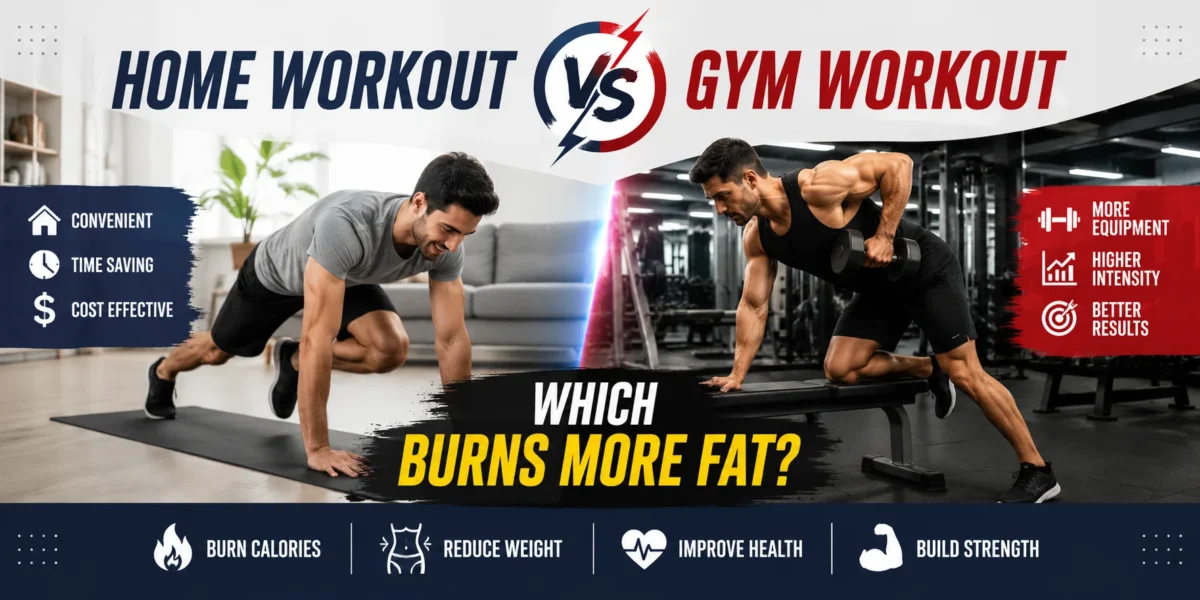
If you’ve ever stood in your living room in your pajamas, dumbbells in hand, wondering whether you’re wasting your time compared to the guy at the gym — you’re not alone. The debate around home workout vs gym workout is one of the most Googled fitness questions of the decade, and for good reason.
Both options have genuinely changed lives. People have lost 30 kilos training in tiny apartments. Others have completely transformed their physique with a gym membership. But which one actually burns more fat? Which one is smarter for your goals, your schedule, and your wallet?
What Does “Burning Fat” Actually Mean?
Before diving into home workout vs gym workout for fat loss, it’s important to understand what fat burning really means.
Fat loss happens when your body is in a caloric deficit — meaning you burn more calories than you consume. Exercise accelerates this process by:
- Increasing your daily calorie expenditure
- Building lean muscle mass (which raises your resting metabolic rate)
- Improving hormonal balance (especially insulin sensitivity)
- Reducing cortisol (the stress hormone that promotes fat storage)
The type of workout matters less than the consistency and intensity of it. But as you’ll see, your environment — home or gym — plays a huge role in both.
Home Workout vs Gym Workout: The Core Difference
When we talk about gym vs home workout, we’re really talking about two different ecosystems:
The Gym gives you access to heavy equipment, a dedicated environment, professional guidance (if you hire a trainer), and a social atmosphere that can push you harder.
Home Workouts give you convenience, zero commute, privacy, no monthly fees (after initial setup), and the ability to train anytime — even at 11 PM in your underwear.
Neither is inherently superior. What matters is which one you’ll actually show up to consistently.
Gym Workout: Pros and Cons
Pros of Gym Workouts
1. Access to Heavy Equipment Barbells, cable machines, squat racks, treadmills, rowing machines — gyms offer tools for progressive overload that are hard to replicate at home. For home workout vs gym workout for muscle gain, the gym has a clear edge here.
2. Dedicated Environment When you walk into a gym, your brain switches into “workout mode.” The environment itself is a psychological cue that boosts focus and effort. Research from the Journal of Environmental Psychology confirms that context-dependent cues significantly influence behavior.
3. Variety of Cardio Options From incline treadmills to Stairmaster to rowing machines, gyms offer diverse cardio tools that maximize calorie burn and reduce boredom — key for home workout vs gym workout for fat loss.
4. Professional Guidance Personal trainers, group classes, and even just watching experienced lifters can accelerate your learning curve and reduce injury risk.
5. Social Accountability Seeing others work hard creates a natural motivation boost. Many people train harder in a gym simply because of the social atmosphere.
6. Structured Programs Many gyms offer structured programs, fitness assessments, and progressive plans that are well-suited for both beginners and advanced athletes.
Cons of Gym Workouts
1. Cost Monthly memberships range from ₹500 to ₹5,000+ in India, or $10–$100+ in the US. Add in commute costs and it adds up quickly.
2. Commute Time If your gym is 30 minutes away, that’s an extra hour per session. Over a month, that’s 20+ hours — time that many people simply don’t have.
3. Crowds and Wait Times Peak hours mean waiting for equipment, which breaks momentum and reduces workout efficiency.
4. Intimidation Factor Gym anxiety is real, especially for beginners or women. Studies show that home workout vs gym workout female preferences often lean toward home workouts due to comfort and privacy concerns.
5. Fixed Hours Most gyms close late at night or early in the morning. If you’re a shift worker or have an unpredictable schedule, this can be a real obstacle.
Home Workout: Pros and Cons
Pros of Home Workouts
1. Zero Commute, Maximum Convenience No travel time, no parking hassle, no waiting for equipment. You can literally roll out of bed and start training.
2. Cost-Effective A set of resistance bands (₹500–₹1,500), a pair of dumbbells, and a yoga mat are enough to get started. No recurring fees.
3. Privacy and Comfort For people who feel self-conscious at gyms — especially home workout vs gym workout female considerations — training at home removes all social pressure.
4. Flexible Timing Train at 5 AM, during lunch, or at midnight. Your schedule, your rules.
5. Effective for Fat Loss and Cardio HIIT (High-Intensity Interval Training), Tabata, bodyweight circuits, and jump rope can burn more calories in 20 minutes than a casual 45-minute gym session. For gym vs home workout calorie burn, intensity matters more than location.
6. Lower Psychological Barrier When the gym is your living room, there’s no excuse not to show up. No commute to dread, no locker room to deal with.
Cons of Home Workouts
1. Limited Equipment Progressing with heavy compound lifts (deadlifts, squats, bench press) is difficult without a proper setup. For serious home workout vs gym workout for muscle gain, this is a limitation.
2. Distractions Kids, TV, phone calls, your couch — the home environment is full of distractions that a gym simply doesn’t have.
3. Lack of Variety Without equipment, workouts can become repetitive, leading to adaptation (where your body stops responding) and boredom.
4. No Professional Oversight Without a trainer or coach, form errors and programming mistakes are common, increasing injury risk over time.
5. Motivation Can Drop Without the social energy of a gym or accountability from others, some people struggle to push as hard at home.
Home Workout vs Gym Workout for Weight Loss: What the Science Says
Here’s the honest truth: both work equally well for weight loss — if intensity and consistency are matched.
A 2019 study published in the International Journal of Environmental Research and Public Health found that home-based exercise programs were just as effective as gym-based programs for weight loss and cardiovascular improvements when participants followed structured plans.
Another study from PLOS ONE (2017) showed that HIIT performed at home with just bodyweight could produce similar fat loss results to machine-based gym workouts over a 12-week period.
The key variable? Consistency over time.
However, for home workout vs gym workout for fat loss at higher intensities (think heavy lifting + metabolic conditioning), the gym typically offers advantages due to equipment variety and the ability to progressively overload muscles — which is critical for long-term fat loss through improved body composition.
Home Workout vs Gym Workout for Muscle Gain
If your goal is significant muscle gain, the honest answer leans toward the gym — at least initially.
Why? Progressive overload — the principle of gradually increasing resistance — is the primary driver of muscle growth. Bodyweight exercises have limits. You can only make a push-up so hard before you’ve maxed out the stimulus.
That said, home workouts can build muscle effectively if you:
- Use resistance bands with progressive resistance levels
- Invest in adjustable dumbbells or a barbell set
- Focus on tempo training and time under tension
- Progress to harder variations (archer push-ups, pistol squats, etc.)
For home workout vs gym workout for muscle gain, the gym wins if we’re talking about maximizing hypertrophy. But for average fitness goals, a well-designed home program is absolutely sufficient.
Gym or Home Workout — Which Is Better for Weight Loss?
This is one of the most asked questions in fitness: gym or home workout which is better for weight loss?
The answer depends on you:
- If you’re disciplined, motivated, and consistent — home workouts are equally effective for weight loss.
- If you need the structure, accountability, or heavy equipment to stay committed — gym workouts may produce better long-term weight loss results because you’ll actually stick to them.
Ultimately, the best workout for weight loss is the one you do regularly and at sufficient intensity. Location is secondary.
Gym or Home Workout — Which Is Better for Weight Gain?
Gym or home workout which is better for weight gain (in terms of lean muscle mass)?
For weight gain — specifically lean muscle mass — the gym has a structural advantage. Heavy compound movements like squats, deadlifts, and bench press are proven mass builders that are difficult to replicate without proper equipment.
If you’re serious about gaining significant weight/muscle:
- A gym (or a well-equipped home gym) is more effective
- Pair it with a caloric surplus and high-protein diet
- Consider progressive overload programs like Starting Strength or GZCLP
For modest weight gain goals, home workouts with resistance bands and adjustable dumbbells can still produce good results.
Gym vs Home Workout Results: Real-World Data
According to a survey by the American College of Sports Medicine (ACSM), home workouts increased by over 80% during 2020–2022, and participants reported comparable satisfaction and results to gym-based training — especially for fat loss and cardiovascular health.
A meta-analysis published in Sports Medicine (2021) reviewing 24 studies concluded: “Exercise location (home vs. gym) was not a significant predictor of fat loss outcomes when total weekly exercise volume was equated.”
In short: gym vs home workout results are similar when effort and structure are matched.
Home Workout vs Gym Workout Benefits: A Side-by-Side Comparison
| Factor | Home Workout | Gym Workout |
|---|---|---|
| Fat Loss Effectiveness | High (with HIIT/consistency) | High (with equipment variety) |
| Muscle Gain | Moderate | High |
| Cost | Low (one-time setup) | Medium-High (monthly fees) |
| Convenience | Very High | Moderate |
| Equipment Variety | Low-Moderate | Very High |
| Privacy | Very High | Low-Moderate |
| Motivation/Energy | Low-Moderate | High |
| Professional Guidance | Low | High |
| Flexibility of Timing | Very High | Moderate |
| Suitable for Beginners | High | Moderate-High |
Case Study: Two People, Two Approaches, Same Goal
Case Study 1 — Charlotte Miller (Home Workout)
Age: 32 | Goal: Lose 12 kg | Location: Mumbai, India
Charlotte Miller had a demanding job and two young kids. She couldn’t commit to a gym schedule. She started a structured 45-minute home HIIT program five days a week using YouTube workouts and a set of resistance bands.
Result after 6 months:
- Lost 11.5 kg
- Reduced body fat from 34% to 26%
- Improved cardiovascular endurance significantly
- Zero gym fees spent
Key Factor: Consistency. She trained at 5:30 AM before her kids woke up, removing all scheduling barriers.
Case Study 2 — Kevin White (Gym Workout)
Age: 28 | Goal: Build muscle and lose body fat | Location: Delhi, India
Kevin White wanted a complete body transformation — less fat, more muscle. He joined a gym and followed a structured 5-day push/pull/legs program with progressive overload.
Result after 6 months:
- Lost 9 kg of fat
- Gained approximately 4 kg of lean muscle
- Significantly improved strength benchmarks
- Monthly gym cost: ₹2,000
Key Factor: Access to heavy equipment and a structured program designed for body recomposition.
What These Cases Tell Us
Both achieved significant fat loss. Charlotte Miller did it at home; Kevin White did it at the gym. The difference? Kevin White gained more muscle due to equipment access, while Charlotte Miller had better consistency due to convenience.
The right choice depends on your primary goal and lifestyle.
Home Workout vs Gym Workout for Women
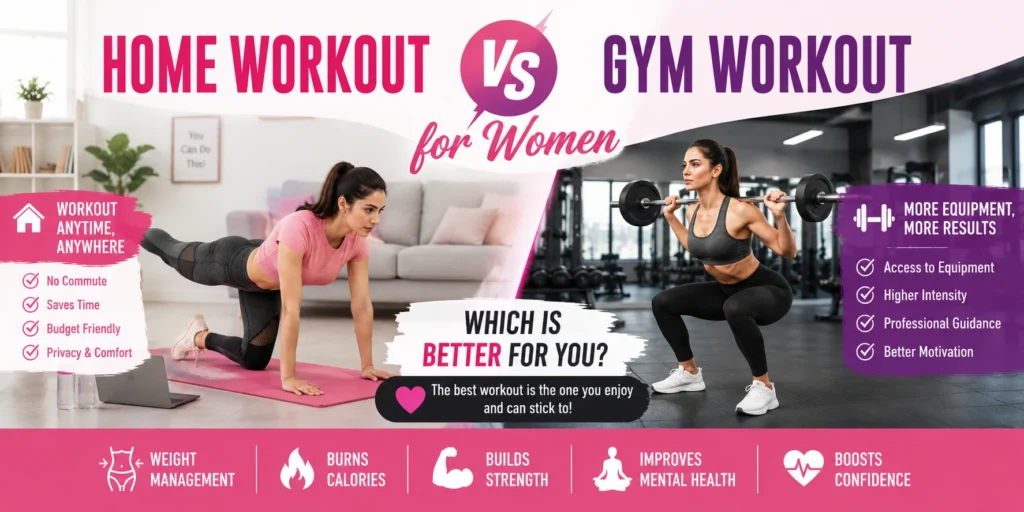
The home workout vs gym workout female debate deserves its own mention because the barriers women face in gym environments are real — from unsolicited advice to uncomfortable staring.
Many women find home workouts empowering because:
- No judgment about what you’re wearing
- Freedom to try new exercises without self-consciousness
- Flexibility to train during nap times, lunch breaks, or after work
- Growing online communities for accountability (YouTube, Instagram, apps like Nike Training Club)
That said, women who join supportive gym environments (women-only gyms, small group classes) often report stronger results in body composition due to structured progressive overload.
For women focused on fat loss specifically, both work. For women focused on muscle tone and body recomposition, a gym setup — or a well-equipped home gym — offers better tools.
How to Make Either Option Work for Fat Loss
Regardless of whether you choose workout at home vs gym, here are universal principles that drive fat loss:
1. Prioritize High-Intensity Training HIIT burns 25–30% more calories than moderate-intensity steady-state cardio, according to research from the British Journal of Sports Medicine.
2. Build Muscle to Boost Metabolism Each pound of muscle burns approximately 6 calories per day at rest vs. 2 calories for fat. More muscle = higher resting calorie burn.
3. Track Your Nutrition Exercise alone rarely produces significant fat loss without dietary changes. Apps like MyFitnessPal or Cronometer help track caloric intake.
4. Stay Consistent for 12+ Weeks Real fat loss results take time. Both home and gym workouts require at least 3 months of consistent effort before significant changes are visible.
5. Progressive Overload Always challenge your body slightly more than last time — more reps, more resistance, less rest. This principle applies equally at home and the gym.
6. Sleep and Recovery Poor sleep raises cortisol and ghrelin (hunger hormone), actively working against fat loss. Aim for 7–9 hours per night.
Frequently Asked Questions (FAQs)
Q1: Gym or home workout — which is better for weight loss?
Both can be equally effective for weight loss when intensity and consistency are matched. Home workouts are ideal if you struggle with time and convenience barriers, while gyms offer more variety and social accountability. Research shows that the best workout for weight loss is the one you actually do consistently over time.
Q2: Gym or home workout — which is better for weight gain?
For building significant lean muscle mass (weight gain in terms of muscle), gym workouts generally have the advantage due to access to heavy compound equipment. However, home workouts with adjustable weights, resistance bands, and progressive calisthenics can produce meaningful muscle growth, especially for beginners and intermediate trainees.
Q3: Home workout vs gym workout for weight loss — which delivers faster results?
Speed of results depends more on workout intensity and nutrition than location. A high-intensity home HIIT program can produce faster fat loss than a casual gym session. That said, gyms with structured programs and progressive overload tools often deliver better long-term results for body recomposition.
Q4: Home workout vs gym workout — which is better for females?
For women, the choice is highly personal. Home workouts offer privacy, comfort, and flexibility — particularly important for those with gym anxiety or busy family schedules. Gym workouts offer better equipment for body sculpting and muscle toning. Many women find the best results by combining both: gym for strength training, home workouts for cardio and recovery days.
Q5: Home workout vs gym workout for muscle gain?
Gym workouts are superior for maximizing muscle gain due to access to progressive resistance and compound movements. However, home workouts using dumbbells, barbells, resistance bands, or bodyweight progressions (weighted vest, harder variations) can absolutely build muscle — they just require more creativity and planning.
Q6: Home workout vs gym workout for fat loss — which burns more calories?
Calorie burn depends on intensity, not location. A 30-minute home HIIT circuit can burn 300–450 calories — comparable to or exceeding a 45-minute moderate gym session. For maximum fat loss, focus on increasing workout intensity rather than debating the setting.
Q7: What are the main benefits of home workout vs gym workout?
Home workouts offer unmatched convenience, zero commute, privacy, flexible timing, and low cost. Gym workouts offer equipment variety, progressive overload potential, professional guidance, and social motivation. The “benefit” depends entirely on which factors matter most to your lifestyle and goals.
Q8: Gym vs home workout — what do results actually look like after 3 months?
Studies comparing gym vs home workout results over 12 weeks show comparable fat loss outcomes when effort is equated. Gym participants typically show greater strength gains, while home participants report higher adherence rates. Both groups show meaningful improvements in body composition, cardiovascular health, and mental well-being.
The Verdict: Which Burns More Fat?
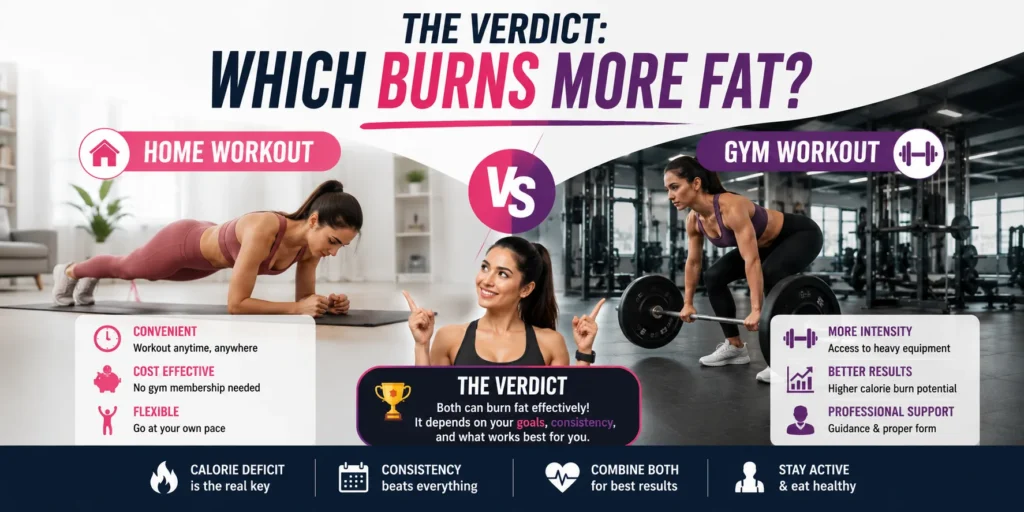
Here it is, straight — no single workout environment burns more fat on its own. What burns fat is:
- Consistency (showing up 4–5 times per week)
- Intensity (pushing hard enough to challenge your cardiovascular and muscular systems)
- Progressive overload (continuously challenging your body)
- Nutrition (being in a caloric deficit)
The gym gives you better tools for muscle building, progressive overload, and variety. Home workouts give you better consistency through convenience, zero barriers, and flexibility.
The smartest approach? Choose the one you’ll stick to. Or, better yet, combine both — gym for strength training, home for cardio and active recovery.
Final Thoughts
The home workout vs gym workout debate is really just a question of lifestyle fit. Both approaches have produced extraordinary results for millions of people worldwide. There’s no “better” answer — only the answer that works for you.
If you’re trying to lose fat, stop waiting for the perfect environment. The best workout is the one you start today.
References & Sources
- García-Hermoso, A., et al. (2019). Home-based exercise is as effective as gym-based exercise for weight loss. International Journal of Environmental Research and Public Health. https://www.mdpi.com/1660-4601/16/10/1729
- Wewege, M., et al. (2017). The effects of high-intensity interval training vs. moderate-intensity continuous training on body composition in overweight adults. Obesity Reviews. https://onlinelibrary.wiley.com/doi/10.1111/obr.12532
- Drenowatz, C., & Greier, K. (2021). Association between exercise location and physical activity levels. Sports Medicine. https://link.springer.com/article/10.1007/s40279-021-01503-5
- American College of Sports Medicine. (2022). ACSM’s Guidelines for Exercise Testing and Prescription. Wolters Kluwer. https://www.acsm.org/
- Baz-Valle, E., et al. (2021). Home-based resistance training is an effective alternative to gym-based resistance training for older adults. PLOS ONE. https://journals.plos.org/plosone/article?id=10.1371/journal.pone.0247002
- Falcone, P.H., et al. (2015). Caloric expenditure of aerobic, resistance, or combined high-intensity interval training. Journal of Strength and Conditioning Research. https://journals.lww.com/nsca-jscr/
- Tremblay, A., et al. (1994). Impact of exercise intensity on body fatness. Metabolism. Referenced in British Journal of Sports Medicine meta-analyses.
- McPherron, A.C., et al. (2013). Increasing muscle mass to improve metabolism. Adipocyte Journal, NCBI. https://www.ncbi.nlm.nih.gov/
- Halson, S.L. (2014). Sleep in elite athletes and nutritional interventions to enhance sleep. Sports Medicine. https://link.springer.com/article/10.1007/s40279-014-0147-0
- Walker, M. (2017). Why We Sleep: Unlocking the Power of Sleep and Dreams. Scribner. Referenced for sleep-cortisol-fat connection.
👉 Ready to take the next step toward better health? Explore our complete guide here →

Other Articles