





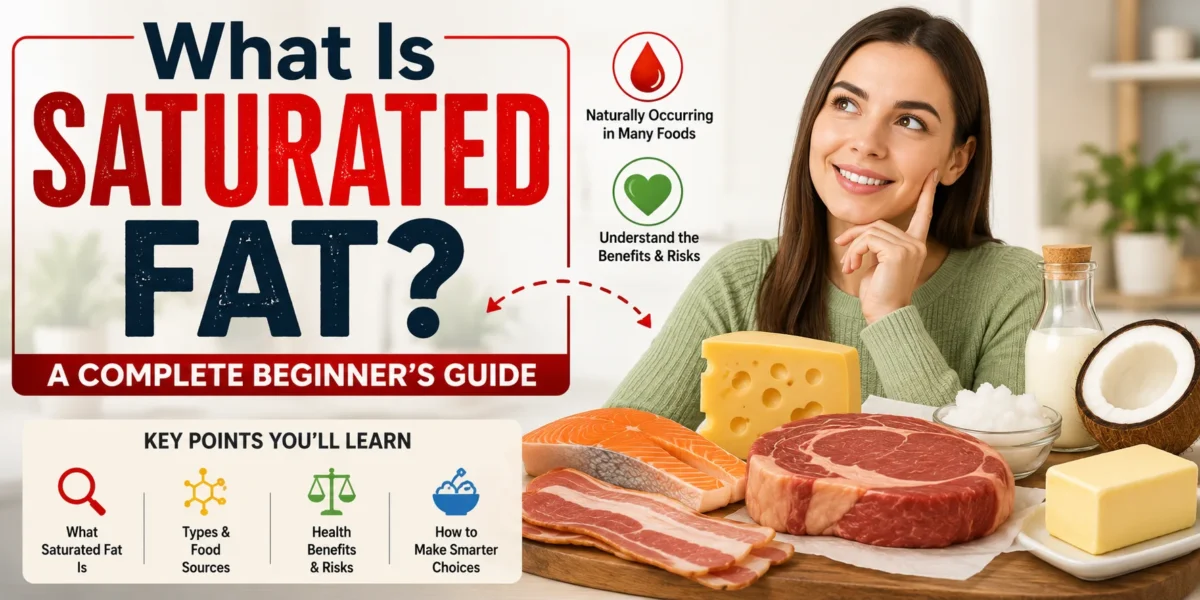
If you’ve ever stood in a grocery store aisle trying to choose between a “low-fat” product and a “full-fat” option, you’re certainly not alone. Nutrition advice has changed dramatically over the years, leaving many people confused about what truly belongs in a healthy diet.
For decades, saturated fat was widely blamed for increasing the risk of heart disease. As a result, food manufacturers reformulated products, health experts encouraged low-fat eating, and dietary recommendations shifted accordingly. However, newer research has revealed that the relationship between diet and health is more complex than once believed.
So, what does the latest science actually say? In this beginner’s guide, you’ll learn what saturated fat is, where it comes from, its potential health effects, and how to make informed choices as part of a balanced diet.
What Is Saturated Fat? The Simple Explanation
Let’s start with the basics. Saturated fat is one of the main types of dietary fat found in many everyday foods. Like all fats, it is made up of fatty acids, but what makes it unique is its chemical structure.
Unlike unsaturated fats, these fatty acids contain no double bonds between their carbon atoms. Instead, every carbon atom is fully bonded with hydrogen, creating a tightly packed structure. This is why foods such as butter, coconut oil, and the visible fat on red meat are usually solid at room temperature, while oils like olive and avocado remain liquid.
Understanding how saturated fat is structured helps explain why it behaves differently during cooking, storage, and digestion. It also provides important context for the ongoing discussion about its role in a balanced, healthy diet.
Types of Saturated Fat: Not All Are Created Equal
One of the most important things to understand about saturated fat is that it isn’t a single substance. Instead, it is a group of different fatty acids, each with its own carbon chain length and unique effects in the body. This is why researchers continue to study saturated fat in greater detail rather than treating every type the same.
The most common saturated fatty acids include:
Lauric Acid (C12): Found mainly in coconut oil and palm kernel oil. Research suggests it may increase HDL (“good”) cholesterol along with LDL cholesterol.
Myristic Acid (C14): Commonly found in dairy products and certain tropical oils. It is considered one of the fatty acids most likely to raise LDL cholesterol levels.
Palmitic Acid (C16): The most abundant fatty acid in both the human diet and body fat. It is present in meat, dairy products, and palm oil. Your liver can also produce it when excess carbohydrates are consumed.
Stearic Acid (C18): Found in beef, cocoa butter, and dark chocolate. Unlike many other fatty acids, it is largely converted into oleic acid in the liver and appears to have a relatively neutral effect on cholesterol.
Recognizing these differences helps explain why not every form of saturated fat affects health in exactly the same way. A balanced understanding of Its focuses on the specific fatty acids, overall eating patterns, and lifestyle rather than relying on broad generalizations.
Where Does Saturated Fat Come From? Common Food Sources
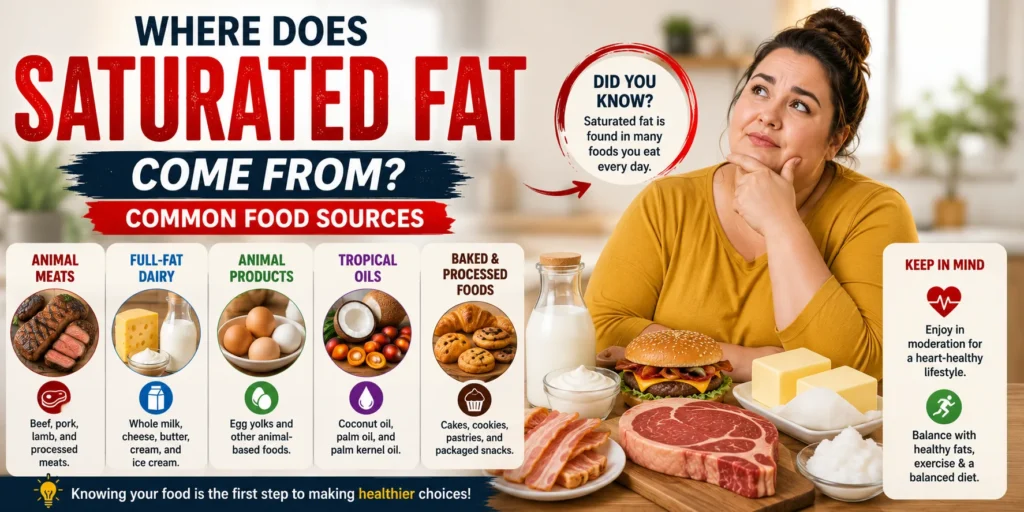
Its is found in a wide range of both animal and plant-based foods. Here are the most common sources:
Animal-Based Sources: Butter and ghee are among the richest dietary sources of saturated fat. Full-fat dairy products such as cheese, whole milk, cream, and yogurt also contain significant amounts. Red meats, including beef, pork, and lamb, provide moderate to high levels, while poultry skin, lard, bacon, and sausage are additional common sources.
Plant-Based Sources: Coconut oil is one of the most concentrated plant-based fats, with around 90% of its fat made up of saturated fat. Palm oil, palm kernel oil, and cocoa butter are other notable sources commonly found in cooking oils and chocolate products.
Processed and Packaged Foods: Many baked goods, cookies, crackers, pastries, and packaged snacks contain these fats through ingredients such as butter, palm oil, or other solid fats. Checking nutri
Saturated Fat vs. Other Fats: A Comparison Table
Understanding how saturated fat stacks up against other dietary fats can help you make smarter choices for your health. Here’s a clear breakdown:
| Fat Type | Chemical Structure | State at Room Temp | Common Sources | Effect on Cholesterol | Overall Health Impact |
|---|---|---|---|---|---|
| Saturated Fat | No double bonds | Solid | Butter, red meat, coconut oil, full-fat dairy | Raises LDL; may raise HDL | Neutral to mixed; context-dependent |
| Monounsaturated Fat | 1 double bond | Liquid | Olive oil, avocados, almonds | Lowers LDL; raises HDL | Generally positive |
| Polyunsaturated Fat (Omega-6) | Multiple double bonds | Liquid | Sunflower oil, soybean oil, corn oil | Lowers LDL | Positive in moderation |
| Polyunsaturated Fat (Omega-3) | Multiple double bonds | Liquid | Fatty fish, flaxseeds, walnuts | Lowers triglycerides | Strongly positive |
| Trans Fat (artificial) | Modified double bonds | Solid | Partially hydrogenated oils, some margarines | Raises LDL; lowers HDL | Negative — avoid |
| Trans Fat (natural/ruminant) | Modified double bonds | Solid | Grass-fed beef, dairy (CLA) | Neutral to positive | Likely neutral or positive |
As this comparison shows, Its occupies a complicated middle ground among healthy fats. It is neither the dietary villain it was once portrayed as, nor something to consume without any thought.
The Saturated Fat and Heart Disease Debate
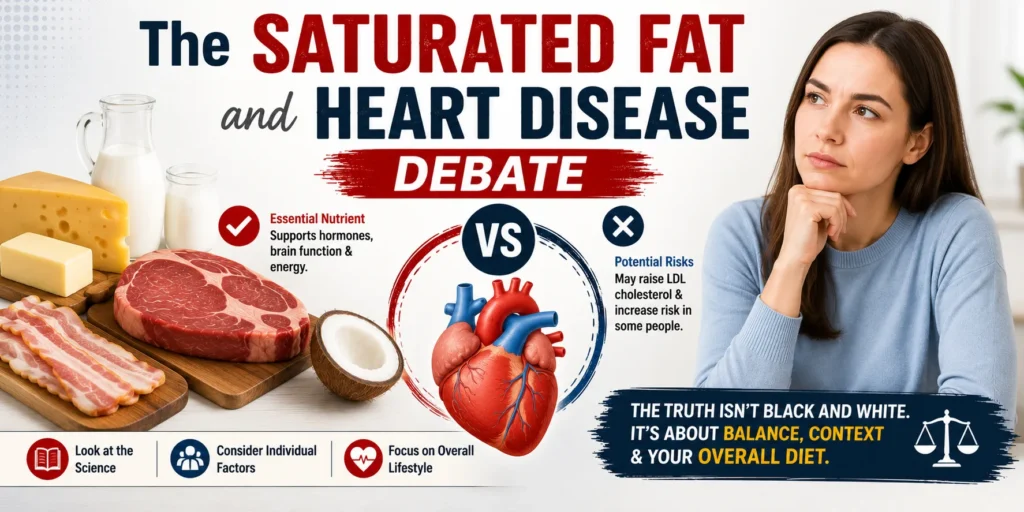
For many years, health experts believed that saturated fat was a major cause of high cholesterol and heart disease. This idea, largely based on the diet-heart hypothesis proposed by researcher Ancel Keys during the 1950s and 1960s, influenced nutrition recommendations and dietary guidelines around the world for decades.
As nutrition science advanced, researchers began re-examining this belief. A widely cited 2010 meta-analysis published in the American Journal of Clinical Nutrition reviewed data from 21 prospective studies involving nearly 350,000 participants and found no significant link between higher saturated fat intake and an increased risk of cardiovascular disease.
Another major review published in Annals of Internal Medicine in 2014 reached a similar conclusion. It suggested that replacing these fats with refined carbohydrates offered little benefit and, in some cases, could even have negative health effects.
Today, experts generally agree that the relationship between diet and heart health is more complex than once thought. Factors such as the foods that replace dietary fats, the specific fatty acids consumed, a person’s genetics, lifestyle habits, and overall eating pattern all play an important role in determining long-term cardiovascular health.
Saturated Fat Benefits: What the Research Actually Says
One of the most interesting parts of this guide is that saturated fat isn’t simply “good” or “bad.” Modern research suggests it may offer certain health benefits when consumed in appropriate amounts as part of a balanced diet. While more studies are ongoing, several findings are supported by peer-reviewed research.
Supports Hormone Production
Its helps provide the building blocks needed to produce important steroid hormones such as testosterone, estrogen, and cortisol. Diets that are extremely low in fat may negatively affect hormone balance in some individuals.
Supports Brain Health
The brain is made up largely of fat, and healthy fats play an essential role in maintaining nerve cell structure and the protective myelin sheath. Getting enough dietary fat may contribute to normal cognitive function and overall neurological health.
May Increase HDL (“Good”) Cholesterol
Certain fatty acids, including lauric acid and stearic acid, have been shown to raise HDL cholesterol levels. Higher HDL cholesterol is generally associated with better cardiovascular health in many people.
Supports Immune Function
Lauric acid, found in coconut oil and human breast milk, has demonstrated antimicrobial activity in laboratory research. Although human studies are still limited, these findings suggest saturated fat from certain food sources may contribute to normal immune function.
May Influence LDL Particle Size
Research indicates that dietary fats can affect the size and type of LDL cholesterol particles. Some studies suggest saturated fat may shift LDL toward larger, less dense particles, which are considered less concerning than small, dense LDL particles.
Helps Absorb Fat-Soluble Vitamins
Vitamins A, D, E, and K require dietary fat for proper absorption. Foods such as eggs, dairy products, and liver naturally provide these vitamins along with healthy amounts of fat, helping the body utilize these essential nutrients more effectively.
Saturated Fat in the American Diet: A Case Study
To better understand the role of saturated fat in everyday diets, it’s helpful to examine what happened in the United States during the low-fat nutrition movement.
After the first Dietary Guidelines for Americans were introduced in 1980, millions of people began reducing their overall fat intake. National survey data showed that average fat consumption fell from around 40–45% of daily calories in the 1960s to roughly 33–34% by the 1990s.
In response, food manufacturers introduced a wide variety of low-fat and fat-free products. To improve taste and texture, many of these products contained added sugars, refined starches, and high-fructose corn syrup instead of fat.
Despite these changes, obesity rates increased significantly over the following decades. According to the CDC, adult obesity prevalence rose from about 15% in 1980 to more than 42% by 2020. During the same period, the number of people diagnosed with type 2 diabetes also continued to grow.
Researchers from institutions including the Harvard School of Public Health reported that replacing saturated fat with refined carbohydrates did not produce the expected reduction in heart disease risk. In some populations, diets higher in refined carbohydrates were linked with poorer metabolic health.
Key Findings from U.S. Studies
- The Nurses’ Health Study, which followed more than 80,000 women, found that replacing 5% of calories from saturated fat with refined carbohydrates did not significantly reduce cardiovascular disease risk. However, replacing those calories with polyunsaturated fats was associated with improved heart health.
- A 2017 CDC analysis also found that more than 70% of American adults consumed more added sugar than recommended, suggesting that excessive intake of refined carbohydrates may play a major role in chronic disease.
This experience highlights an important lesson: overall dietary quality matters more than focusing on a single nutrient. A diet centered on whole, minimally processed foods produces very different health outcomes than one dominated by highly processed, high-sugar products.
How Much Saturated Fat Should You Eat Per Day?
Current nutrition recommendations vary slightly among major health organizations, but they generally encourage moderation rather than complete avoidance.
- The American Heart Association (AHA) recommends limiting saturated fat to about 5–6% of total daily calories. For a 2,000-calorie diet, this equals roughly 11–13 grams per day.
- The 2020–2025 Dietary Guidelines for Americans suggest keeping saturated fat below 10% of total daily calories, or approximately 22 grams on a 2,000-calorie diet.
- The World Health Organization (WHO) also recommends consuming less than 10% of total daily energy from these fats.
Some researchers and healthcare professionals support a more personalized approach, noting that genetics, metabolic health, food quality, and overall eating patterns can influence how individuals respond to different types of dietary fat.
For most people, a sensible strategy is to consume fat in moderation by choosing nutrient-rich, minimally processed foods such as full-fat dairy products, unprocessed meats, and coconut products, while limiting highly processed foods that combine solid fats with refined sugars and starches.
Saturated Fat and the Ketogenic Diet
No saturated fat guide in 2026 would be complete without addressing the ketogenic (keto) diet, which has become enormously popular in the United States and worldwide.
On a ketogenic diet, fat typically comprises 70–80% of total calories, and saturated fat — from sources like butter, ghee, coconut oil, fatty cuts of meat, and full-fat dairy — is consumed in large quantities. Proponents argue that when carbohydrate intake is restricted, the body shifts to burning fat for fuel in a process called ketosis, which can improve metabolic health.
Clinical research on ketogenic diets has shown promising results for weight loss, blood sugar control in type 2 diabetes, and reduction in triglycerides and certain cardiovascular risk markers — even with high saturated fat intake. However, long-term studies (beyond 2 years) remain limited, and some individuals on high-fat diets do experience significant increases in LDL cholesterol.
Whether a ketogenic approach is appropriate for you depends on your personal health history, goals, and lipid response — a conversation best had with a qualified healthcare provider.
Practical Tips for Managing Saturated Fat Intake
Whether you’re looking to build a healthier eating pattern or simply make smarter food choices, these practical tips can help you include saturated fat in a balanced diet.
Monitor your personal health. Regular cholesterol checks, triglyceride measurements, and discussions with your healthcare provider can help determine the dietary approach that best fits your individual needs.
Choose whole-food sources. Foods such as grass-fed beef, full-fat Greek yogurt, eggs, and natural dairy products provide beneficial nutrients alongside dietary fat, unlike many highly processed snacks and desserts.
Pair fat with fiber. Combining meals with vegetables, legumes, fruits, or whole grains can help support healthy blood sugar levels and overall heart health.
Avoid replacing fat with added sugar. Nutrition research suggests that swapping healthy foods for products high in refined sugars and starches is unlikely to improve long-term health.
Focus on your overall diet. Healthy eating patterns, such as the Mediterranean diet, include moderate amounts of saturated fat along with olive oil, fish, vegetables, legumes, nuts, fruits, and whole grains.
Frequently Asked Questions (FAQ)
Q1: What is saturated fat in simple terms?
Saturated fat is a type of dietary fat whose molecules contain no double bonds between carbon atoms, making them fully “saturated” with hydrogen. This structure makes them solid at room temperature. Common examples include butter, coconut oil, and the fat in red meat and dairy products.
Q2: Is saturated fat bad for you?
The answer is more nuanced than a simple yes or no. Moderate amounts of saturated fat from whole-food sources (like dairy and unprocessed meat) do not appear to significantly increase cardiovascular disease risk for most people. However, excessive consumption — particularly combined with refined carbohydrates and a sedentary lifestyle — may contribute to adverse health outcomes. Context, total dietary pattern, and individual genetics all play important roles.
Q3: What are the main saturated fat benefits?
Potential saturated fat benefits include supporting hormone production, contributing to brain and nervous system health, raising HDL cholesterol, aiding fat-soluble vitamin absorption, and (in the case of lauric acid) potential antimicrobial properties. These benefits apply most reliably when saturated fat is consumed as part of a balanced, whole-food diet.
Q4: What is the difference between saturated fat and trans fat?
Its occurs naturally in animal and some plant foods and appears to have neutral to mixed health effects depending on type and context. Artificial trans fat (from partially hydrogenated oils) is processed, raises LDL, lowers HDL, and is strongly associated with cardiovascular disease. Artificial trans fats have been largely banned in the U.S. since 2018.
Q5: Which foods are highest in saturated fat?
The foods highest in saturated fat include coconut oil (approximately 90% saturated), butter and ghee (approximately 65%), palm oil (approximately 50%), full-fat cheese (approximately 20–30 grams per 100g), beef and lamb (varies widely by cut), and dark chocolate or cocoa butter.
Q6: How much saturated fat per day is safe?
Current guidelines suggest keeping saturated fat below 10% of total daily calories — about 22 grams on a 2,000 calorie diet. Some organizations, like the American Heart Association, recommend a stricter limit of 5–6%. Individual needs may vary based on health status, genetics, and overall diet quality.
Q7: Are healthy fats and saturated fats the same thing?
Not exactly. The term healthy fats is often used to describe unsaturated fats (monounsaturated and polyunsaturated) that have well-established cardiovascular benefits. However, some sources of saturated fat — particularly from minimally processed whole foods — can absolutely be part of a healthy diet. The most “healthy fats” are typically whole-food sources of any fat type consumed as part of an overall balanced dietary pattern.
Q8: Does cooking with saturated fat change its health properties?
One practical advantage of saturated fat is its stability at high heat. Because saturated fats have no double bonds to oxidize, they are far more heat-stable than polyunsaturated oils (like sunflower or corn oil), which can produce harmful oxidation products when heated at high temperatures. This makes saturated fats like butter, ghee, and coconut oil reasonable choices for high-heat cooking.
Conclusion: A Smarter Way to Think About Saturated Fat
After decades of being viewed as a dietary villain, saturated fat is now being examined with a more balanced perspective. Current nutrition research suggests that the answer is not as simple as labeling it either harmful or harmless. Instead, its health effects depend on factors such as the amount consumed, the food source, and the overall quality of the diet.
At its core, saturated fat is a naturally occurring dietary fat that has been part of the human diet for thousands of years. It plays important roles in the body, including supporting normal cell structure, hormone production, and the absorption of certain nutrients. Modern research also indicates that the relationship between dietary fat and heart health is more complex than previously believed.
The key takeaway is to focus on a balanced eating pattern built around whole, minimally processed foods. Choosing quality food sources, limiting highly processed products rich in refined sugars, and considering your individual health needs are all more important than fearing a single nutrient. When consumed in moderation as part of a healthy lifestyle, It can be included in a nutritious, well-rounded diet.
References and Sources
- Siri-Tarino, P.W., Sun, Q., Hu, F.B., & Krauss, R.M. (2010). Meta-analysis of prospective cohort studies evaluating the association of saturated fat with cardiovascular disease. American Journal of Clinical Nutrition, 91(3), 535–546. https://doi.org/10.3945/ajcn.2009.27725
- Chowdhury, R., Warnakula, S., Kunutsor, S., et al. (2014). Association of dietary, circulating, and supplement fatty acids with coronary risk. Annals of Internal Medicine, 160(6), 398–406. https://doi.org/10.7326/M13-1788
- U.S. Department of Agriculture & U.S. Department of Health and Human Services. (2020). Dietary Guidelines for Americans, 2020–2026. https://www.dietaryguidelines.gov
- American Heart Association. (2021). Saturated Fat. https://www.heart.org/en/healthy-living/healthy-eating/eat-smart/fats/saturated-fats
- World Health Organization. (2023). Healthy Diet. https://www.who.int/news-room/fact-sheets/detail/healthy-diet
- Centers for Disease Control and Prevention. (2022). Adult Obesity Facts. https://www.cdc.gov/obesity/data/adult.html
- Harvard T.H. Chan School of Public Health — The Nutrition Source. Fats and Cholesterol. https://www.hsph.harvard.edu/nutritionsource/what-should-you-eat/fats-and-cholesterol/
- National Institutes of Health — National Heart, Lung, and Blood Institute. (2022). Blood Cholesterol. https://www.nhlbi.nih.gov/health/blood-cholesterol
- Mensink, R.P., Zock, P.L., Kester, A.D., & Katan, M.B. (2003). Effects of dietary fatty acids and carbohydrates on the ratio of serum total to HDL cholesterol and on serum lipids and apolipoproteins. American Journal of Clinical Nutrition, 77(5), 1146–1155.
- Calder, P.C. (2015). Functional Roles of Fatty Acids and Their Effects on Human Health. Journal of Parenteral and Enteral Nutrition, 39(1 Suppl), 18S–32S. https://doi.org/10.1177/0148607115595980

Other Articles