





When did you last ask a man you love — really ask — how he was doing? Not the quick “you good?” in passing, but a real, honest conversation about what’s going on inside?
For most of us, that kind of question still feels awkward. Uncomfortable. Even unnecessary. And that discomfort is exactly the problem.
In 2026, Men’s Mental Health Month is going viral — trending on social media, igniting dinner table conversations, sparking company-wide policy changes, and reshaping how society understands what it means for a man to be truly Men’s Mental Health. After years of being treated as either a niche advocacy topic or an afterthought to broader mental health awareness campaigns, the conversation around men’s emotional well-being has finally exploded into the mainstream.
But why now? What changed? And what does this cultural moment mean for the millions of men silently carrying the weight of depression, anxiety, trauma, and burnout without ever asking for help?
What Is Men’s Mental Health Month?
Men’s Mental Health Month is observed every year in June across the United States and in many countries worldwide. It runs alongside Men’s Mental Health Month — a broader observance covering physical wellness — and includes Men’s Health Week, the week before Father’s Day, making June a powerful, dedicated window to focus on the men in our lives and the struggles they often face in silence.
The month was established to shine a direct, unapologetic light on the mental health challenges unique to men: the stigma that keeps them from speaking up, the societal scripts that tell them strength means silence, and the dangerous gap between how many men suffer and how few actually receive care.
According to the Anxiety and Depression Association of America (ADAA), nearly 1 in 10 men experience depression or anxiety every year — yet fewer than half of them ever seek treatment. That’s not a small number. That’s millions of fathers, brothers, partners, friends, and sons quietly drowning while the world around them tells them to swim harder.
Men’s Mental Health Month exists to change that story. And in 2026, more people than ever are listening.
Why Men’s Mental Health in 2026 Is Different: The Viral Moment Explained
So what made this particular year the tipping point? Several forces converged at once.
1. Social Media Destigmatization
Platforms like TikTok, Instagram, and YouTube have been flooded in 2026 with men — many of them public figures, athletes, and everyday guys — openly discussing their Men’s Mental Health struggles. The raw vulnerability in these posts resonates in a way that polished PSA campaigns never could. When a 28-year-old man in Ohio films himself crying in his car and says “I don’t know how to ask for help,” and that video gets 4 million views, something shifts culturally.
2. Men’s Mental Health Statistics Can No Longer Be Ignored in 2026
The numbers driving mental health awareness in 2026 are staggering. According to data compiled by Leal Mind and cross-referenced with CDC figures:
- <cite>Men die by suicide at nearly four times the rate of women, accounting for approximately 79% of all suicide deaths in the United States.</cite>
- <cite>Over 6 million men in the U.S. experience depression annually, yet the majority never receive a diagnosis or treatment.</cite>
- <cite>Only 41.6% of men with any form of mental illness received treatment in 2023, compared to 56.9% of women.</cite>
- <cite>Suicide-related deaths were four times higher among males (38,977) compared to females (9,847) in 2024, even as overall rates showed a slight decline.</cite>
These numbers have moved beyond clinical journals and into public consciousness. People are angry — and that anger is productive.
3. Workplace Mental Health Culture Is Shifting
Companies in 2026 are increasingly recognizing that burnout, depression, and anxiety in male employees are costing billions in lost productivity and turnover. As a result, mental Men’s Mental Health awareness month campaigns now have corporate backing that didn’t exist five years ago. Employers are funding mental health days, subsidizing therapy, and encouraging open conversations in ways that directly benefit the men who were previously most likely to suffer in silence at their desks.
4. A New Generation Is Redefining Men’s Mental Health Beyond “Man Up”
Younger men — particularly Gen Z and younger Millennials — are rejecting the old masculinity scripts that equate emotional vulnerability with weakness. They grew up watching their fathers and older brothers suffer silently, and they want no part of it. This generational shift is turbocharging the viral reach of mental health month content aimed specifically at men.
The Hidden Face of Men’s Mental Health Struggles
One of the most important things mental health experts stress during Men’s Mental Health Month is that mental in health men’s experience often looks very different from the textbook picture of depression.
Most people imagine depression as someone lying in bed, crying, unable to function. In women, this presentation is common. But in men, Men’s Mental Health struggles frequently wear different masks:
- Irritability and explosive anger — snapping at small frustrations, road rage, sudden outbursts
- Risk-taking behaviors — reckless driving, gambling, impulsive financial decisions, substance use
- Workaholism — throwing themselves obsessively into work as a form of escape
- Physical complaints — chronic headaches, back pain, digestive issues, fatigue with no clear medical cause
- Social withdrawal — pulling away from friends, family, and community
As experts at Psychiatric Times note, <cite>over 50% of men report feeling that no one really knows them — and that profound social isolation correlates directly with adverse health outcomes, including dramatically elevated suicide risk.</cite>
This is why mental health awareness campaigns specifically targeting men matter so much: they help men recognize symptoms they might otherwise dismiss or externalize, and they help the people around them know what warning signs actually look like.
Also Read — Taking care of your mental health can also help reduce stress and support healthy blood pressure naturally.
Mental Health Awareness Month vs. Men’s Mental Health Month: Know the Difference
There is often confusion around the timing of these observances, so let’s clear it up.
Mental Health Awareness Month is observed every May in the United States. It is a broad, inclusive month focused on mental health for everyone — all genders, ages, and backgrounds. It’s supported by major organizations including SAMHSA (Substance Abuse and Mental Health Services Administration) and Mental Health America.
Men’s Mental Health Month is observed every June, running alongside the broader Men’s Health Month. It is specifically focused on the unique challenges, barriers, and experiences that affect men’s psychological well-being.
Both are critically important. May’s mental health awareness month builds the broad cultural foundation. June’s men’s mental health month takes that foundation and directs it toward a population that has historically been the least likely to benefit from it. Together, they create a two-month window that advocates and healthcare professionals are now using more strategically than ever before.
Practical Men’s Mental Health Tips That Actually Work in 2026
Awareness without action is just noise. So let’s talk about what men can actually do — right now, this month, today — to support their own mental well-being.
These mental health tips are grounded in evidence and designed with men’s real-life barriers in mind:
1. Name It to Tame It
Research consistently shows that simply identifying and labeling an emotion reduces its intensity in the brain. You don’t need to deliver a TED talk about your feelings. Try: “I’m stressed.” “I’m overwhelmed.” “I feel like I’m failing.” That’s enough to start. The act of naming the emotion is itself a form of emotional regulation — and it’s a skill, not a personality trait.
2. Build a Men’s Mental Health Routine That Includes You
Men who do well emotionally tend to have daily structure that includes physical activity, social connection, and at least one activity done purely for enjoyment. It sounds simple because it is. But under the pressure of work, relationships, and financial stress, these basics are often the first things sacrificed.
3. Replace “Venting” With Problem-Solving Conversations
Many men find traditional “emotional support” conversations uncomfortable. That’s okay. Reframe the need. Instead of “I need to talk about how I’m feeling,” try: “I’ve been dealing with something and I want to think through it out loud.” This framing tends to feel more natural and purposeful for many men — and it gets the same result.
4. Audit Your Sleep and Alcohol
Two of the biggest contributors to poor mental health in men are disrupted sleep and alcohol use. Both are often used as coping mechanisms, and both make things significantly worse over time. Start here before anything else. Improving sleep quality and reducing alcohol consumption have measurable, relatively rapid effects on mood, cognition, and emotional resilience.
5. Find Your Outlet Before You Need It
Physical activity, creative expression, time in nature, journaling, meditation — whatever your version of a mental release valve looks like, build it into your life now. Not when you’re in crisis. The mistake most men make is treating mental health support as emergency-only. It works far better as maintenance.
Men’s Mental Health Exercises That Help Most in 2026
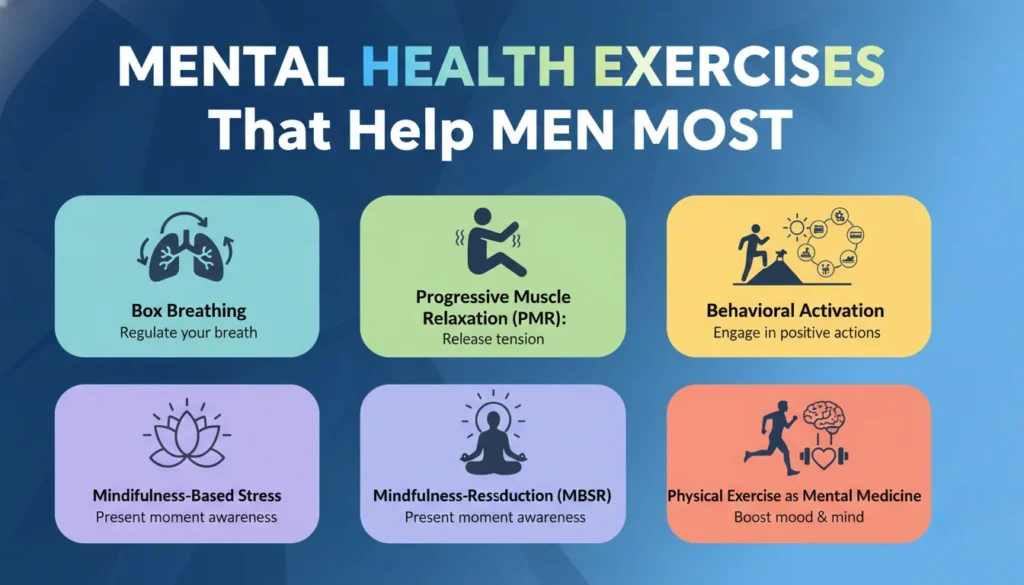
Beyond general lifestyle habits, specific mental health exercises have strong evidence behind them for addressing the types of distress men most commonly experience.
Box Breathing (4-4-4-4): Inhale for 4 counts, hold for 4, exhale for 4, hold for 4. Repeat 4 times. This is used by military special forces and first responders to regulate the nervous system under acute stress. It works quickly and requires no special equipment or setting.
Progressive Muscle Relaxation (PMR): Systematically tensing and releasing muscle groups throughout the body. Particularly useful for men who carry stress physically — in their shoulders, jaw, back. PMR teaches the body to recognize and release held tension.
Behavioral Activation: One of the core techniques in cognitive behavioral therapy (CBT), behavioral activation involves deliberately scheduling pleasurable or meaningful activities even when motivation is low. Depression and anxiety thrive on withdrawal. Behavioral activation directly counters that pattern.
Men’s Mental Health Benefits of Mindfulness-Based Stress Reduction (MBSR): Despite skepticism from some men who find “mindfulness” too abstract, the evidence for MBSR in reducing depression, anxiety, and chronic stress is substantial and well-replicated. Apps like Headspace and Calm have made entry-level mindfulness more accessible and less intimidating.
Physical Exercise as Mental Medicine: The data here is unambiguous. Regular aerobic exercise — particularly running, cycling, swimming, or team sports — produces measurable antidepressant effects. For mild to moderate depression, exercise has been shown in multiple meta-analyses to be as effective as medication. This framing resonates strongly with men who might resist therapy or medication but respond well to performance-oriented goals.
The Role of a Men’s Mental Health Therapist: Breaking the Barrier
Here is where many men get stuck. They might accept that they’re struggling. They might even try some of the mental health exercises above. But the idea of sitting down with a mental health therapist and talking about their inner life still feels like a bridge too far.
Let’s address this directly.
Therapy is not what movies make it look like. A good mental health therapist — particularly one experienced in working with men — is less interested in “how does that make you feel?” and more interested in helping you understand patterns, develop practical tools, and rebuild areas of your life that aren’t working. Good therapy is goal-oriented, structured, and collaborative. It is not a place where you go to be judged or fixed or told you’re broken.
There are also now more options than ever for men who are hesitant:
- Online therapy platforms (BetterHelp, Talkspace, Cerebral) allow sessions from home without having to walk into a clinic
- Male-specific therapy programs pair men with therapists who specialize in male psychology
- Group therapy and peer support allow men to hear from other men going through similar experiences — often the most powerful intervention of all
- Sports-integrated mental health programs embed mental health professionals into gyms, teams, and fitness communities
<cite>In the year before a suicide death, only 35% of men sought care from a mental health practitioner</cite> — which means reaching men before they’re in crisis, and making access easy and destigmatized, is one of the highest-impact interventions available.
If you’re unsure where to start, the 988 Suicide and Crisis Lifeline (call or text 988) is available 24/7 and can connect you with resources specific to your situation and location. SAMHSA’s FindSupport.gov is another excellent starting point.
How Men’s Mental Health Month Is Going Viral: What the Movement Looks Like
The virality of Men’s Mental Health Month in 2026 isn’t accidental. It’s the result of years of groundwork laid by advocates, clinicians, athletes, and — increasingly — ordinary men willing to be publicly honest about their struggles.
Several specific trends are driving the moment:
The “Check In” Challenge: Hashtags encouraging men to publicly check in on the men in their lives went massively viral this June, generating tens of millions of impressions and, more importantly, millions of real conversations.
Athlete Advocacy: High-profile male athletes across the NFL, NBA, soccer, and the Olympics have spoken publicly about therapy, depression, and anxiety in 2026 more than any previous generation. Their credibility with male audiences is enormous.
Employer Campaigns: As part of Mental Health Month and Men’s Health Month initiatives, companies like Google, Microsoft, and major healthcare systems ran internal campaigns specifically addressing men’s mental health, normalizing therapy benefits in environments where the topic had previously been taboo.
Documentary and Podcast Boom: Several widely watched documentaries and massively downloaded podcast episodes dropped in late 2025 and early 2026 focused entirely on men’s mental health — providing the kind of in-depth, narrative storytelling that statistics alone can’t deliver.
The mental health month conversation in 2026 is no longer niche. It’s everywhere. And that visibility is saving lives.
What You Can Do This Month — Right Now
Whether you are a man reading this for yourself, or someone who loves a man who might be struggling, here is what meaningful participation in Men’s Mental Health Month looks like in practice:
For Men’s Mental Health:
- Take an honest inventory of your mental and emotional state. Not a performance review — a real one.
- Identify one person in your life you could talk to honestly about how you’ve been feeling.
- Look up one mental health therapist or online therapy platform this week. Just look. That’s it.
- Try one of the mental health exercises listed in this article for seven days and notice what shifts.
- Call or text 988 if you are struggling and don’t know where else to turn.
For Friends, Partners, and Family:
- Ask the men in your life how they’re doing — and then wait for the real answer.
- Don’t try to fix or minimize. Just listen.
- Offer specific support: “I can drive you to a first therapy appointment if that helps.”
- Share this article. Share the statistics. Normalize the conversation.
- Know the warning signs: irritability, withdrawal, reckless behavior, giving things away, saying goodbye.
For Employers:
- Audit your mental health benefits and make sure employees know how to access them.
- Create space for mental health conversations without stigma or professional consequence.
- Partner with a mental health therapist or Employee Assistance Program (EAP) provider to bring resources directly into the workplace.
The Path Forward: From Awareness to Action
Mental health awareness is necessary but not sufficient. Awareness without access, without destigmatization, and without concrete action leaves men exactly where they’ve been for decades — aware that something is wrong, and completely without a path to fix it.
The viral moment around Men’s Mental Health Month in 2026 is meaningful precisely because it is converting awareness into action at a scale we haven’t seen before. Men are making therapy appointments. Companies are changing policies. Schools are teaching emotional literacy to boys. Athletes are modeling vulnerability. Families are having conversations that should have happened decades ago.
<cite>The 2026 State of Mental Health Report by Rula found that despite growing awareness, financial stress is a rapidly worsening barrier to mental healthcare access</cite> — which means the policy work is far from done. Access must improve. Costs must come down. The mental health therapist pipeline must expand to meet demand.
But culturally? Something has genuinely shifted. The silence around men’s mental health — that suffocating, killing silence — is cracking. And Men’s Mental Health Month is one of the hammers doing the cracking.
Men’s Mental Health Conclusion: Why June Is Just the Beginning
Men’s Mental Health Month gives us 30 dedicated days to focus, to advocate, to reach out, and to act. But the real goal isn’t a viral June. The real goal is a world where men don’t need a dedicated month to feel safe talking about their inner lives — because that safety exists every day, in every relationship, in every workplace, in every doctor’s office.
We’re not there yet. But 2026 feels different. It feels like the year the culture finally caught up to the crisis.
If you’re a man reading this: your mental health matters. Getting help is not weakness — it is, by every clinical definition, the strongest thing you can do. And if you’re reading this for someone else: reach out to him. Today. Not because it’s Men’s Mental Health Month. Because he matters, and he needs to know it.
Authoritative References
- National Institute of Mental Health (NIMH) — https://www.nimh.nih.gov/health/statistics/suicide
Comprehensive suicide statistics and mental health data for the United States. - American Foundation for Suicide Prevention (AFSP) — https://afsp.org/suicide-statistics/
Annual suicide statistics including gender-based breakdowns and trends. - Anxiety and Depression Association of America (ADAA) — https://adaa.org/find-help/by-demographics/mens-mental-health
Men’s mental health facts, statistics, and treatment information. - SAMHSA — Substance Abuse and Mental Health Services Administration — https://www.samhsa.gov/about/digital-toolkits/mental-health-awareness-month
Official Mental Health Awareness Month resources, toolkits, and crisis support information. - Centers for Disease Control and Prevention (CDC) — Suicide Data — https://www.cdc.gov/suicide/facts/data.html
National suicide data, demographic breakdowns, and public health surveillance.

Other Articles

How to Support Healthy Blood Pressure Naturally